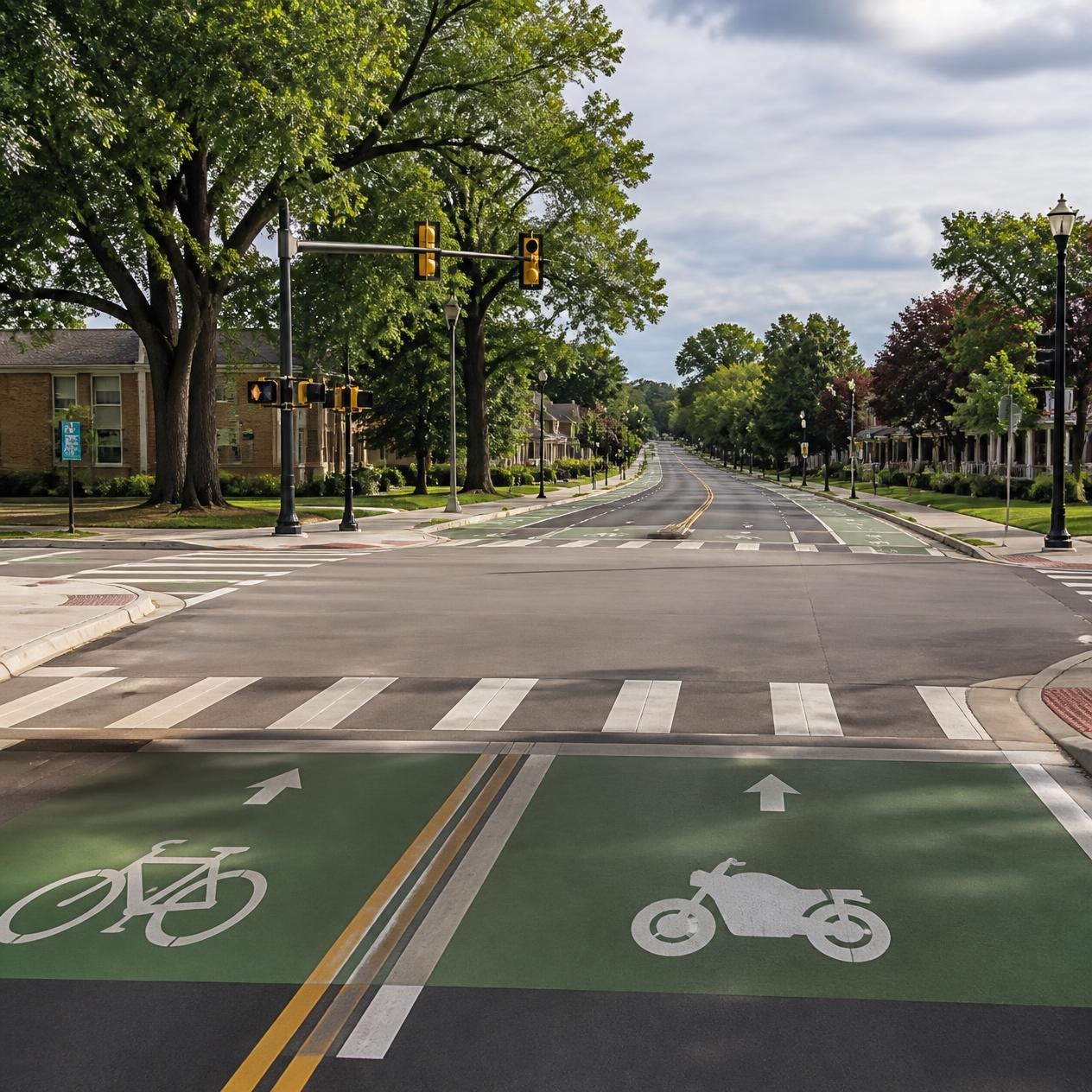
Find answers to common questions about motorcycle and bicycle crashes in Ohio.
We cover a wide range of situations, including intersection collisions, passenger injuries, unsafe passing, dooring, uninsured drivers, hit-and-run crashes, serious injuries, and wrongful death claims.
Ohio does not require all motorcyclists to wear helmets. Under state law, a helmet is required for operators under the age of 18 and for operators in their first year of holding a motorcycle license or endorsement. A passenger must also wear a helmet when riding with an operator who is required to wear one. Adult riders outside these groups may choose whether to wear a helmet.
Ohio law also requires motorcycle operators to wear eye protection, such as glasses or goggles, unless the motorcycle is equipped with a windshield. Even where a helmet is optional, safety organizations strongly encourage riders to wear one approved by the U.S. Department of Transportation. In an injury claim, an insurer may raise helmet use when head injuries are involved, but choosing not to wear a helmet when the law does not require one does not, by itself, prevent a rider from seeking compensation.
In most cases, Ohio gives an injured person two years from the date of the crash to file a personal injury lawsuit. This time limit is known as the statute of limitations. If a lawsuit is not filed before the deadline, the court will likely dismiss the case, even if the other driver was clearly at fault.
Some situations follow different rules. Claims involving minors, for example, may have a deadline that does not begin running until the child turns 18. Claims involving government vehicles or public road conditions may involve additional requirements. Property damage claims for a motorcycle are also generally subject to a two-year limit. Because evidence such as video footage and witness memories can fade long before the deadline arrives, many riders choose to seek legal guidance well in advance. Speaking with a lawyer can help you identify the deadline that applies to your situation.
Ohio follows a modified comparative fault rule. Under this rule, an injured person may still recover damages as long as their share of fault is not greater than the combined fault of the other parties involved. If a rider is found to be more than half responsible, the rider generally cannot recover damages from the other parties.
When a rider can recover, the amount is reduced by the rider’s percentage of fault. For example, if a jury decides a rider was 20 percent responsible, the rider’s damages would be reduced by that percentage. Insurers often look for reasons to assign fault to motorcyclists, such as claims about speed or lane position. For that reason, evidence about how the crash happened can be very important. Photographs, witness statements, and video may help show that the other driver bore most or all of the responsibility.
Yes. Ohio law includes bicycles within its definition of vehicles for purposes of the traffic code. This means that a person riding a bicycle on a public road generally has the same rights as other drivers. It also means cyclists are expected to follow the same traffic rules, including stopping at red lights and stop signs, signaling turns, and riding with the flow of traffic.
This status matters after a crash. Drivers must yield to cyclists in the same situations where they would yield to a car, and they cannot treat a cyclist as an obstacle to be ignored. When a driver fails to respect a cyclist’s right of way, the driver may be responsible for the resulting injuries. Ohio law also includes some rules that apply specifically to bicycles, such as requirements for lights when riding at night. Cities may adopt additional local rules, such as those governing sidewalk riding.
Ohio law generally asks cyclists to ride as near to the right side of the roadway as is practicable. However, the law does not require cyclists to hug the curb in every situation. A cyclist may move farther left when necessary to avoid hazards such as debris, potholes, parked cars, or other obstacles.
A cyclist may also use more of the lane when the lane is too narrow for a vehicle and a bicycle to travel side by side safely. In those situations, riding near the center of the lane can discourage drivers from attempting unsafe passes. Cyclists also move left when preparing to make a left turn. Ohio law allows cyclists to ride two abreast in a single lane. Drivers sometimes become frustrated when a cyclist takes the lane, but that frustration does not excuse unsafe driving. Understanding these rules can help show that a cyclist was riding lawfully at the time of a crash.
It may. Many cyclists are surprised to learn that their own auto insurance policy can provide protection while they are riding a bicycle. Depending on the policy language, medical payments coverage may help pay for treatment after a crash. Uninsured or underinsured motorist coverage may also apply if the driver who hit you had no insurance or not enough insurance.
Whether your policy applies depends on how it defines who is insured and in what situations. Some policies cover the named policyholder and household members as pedestrians and cyclists, while others contain limitations. It is worth reviewing the full policy, not just the summary page. The at-fault driver’s liability insurance is usually the primary source of payment, and health insurance may cover treatment as well. Notifying your own insurer promptly is important, since many policies require timely notice of any possible claim.
In many cases, the driver who turned left bears responsibility. Ohio law requires a driver turning left at an intersection to yield to vehicles approaching from the opposite direction that are within the intersection or close enough to be an immediate hazard. A motorcycle is a vehicle under this rule, so a driver who turns across its path without enough time to do so safely may be found negligent.
These crashes are among the most common types of motorcycle collisions. Drivers often say they did not see the motorcycle, or that the rider seemed farther away than they actually were. Those explanations do not excuse the failure to yield. However, the specific facts still matter. An insurer may argue that the rider was speeding or that the motorcycle was hidden by another vehicle. The outcome of each claim depends on the evidence about speed, visibility, and timing at that intersection.
Intersection crashes often come down to competing accounts, so independent evidence is especially valuable. Video is one of the strongest forms of proof. Traffic cameras, cameras at nearby gas stations and stores, doorbell cameras, and dashcams in other vehicles may have recorded the collision. Because many systems overwrite footage within days, requests to preserve it should be made quickly.
Other helpful evidence includes witness statements from people waiting at the intersection, photographs of vehicle positions and damage, and the police crash report. Signal timing records may help show which direction had a green light. The damage patterns on each vehicle can indicate the angle and speed of impact. In more complex cases, a reconstruction professional may analyze the physical evidence to estimate speeds and sight lines. Gathering this information early gives the best chance of building an accurate picture of what happened.